
Urogynaecology | Bowel diary
Bowel diary
A bowel diary is a practical record of what your bowels are doing over a few typical days or a week. It helps turn a vague story about constipation, blocked emptying, urgency, seepage, or leakage into something we can assess properly.
Bowel diaries are usually kept for somewhere between 3 and 14 days. In practice, a full week is often a very good starting point because it captures weekday and weekend patterns, meals, bowel medicines, urgency, leakage, and stool form much more honestly than memory.
The printable version here follows a full-week layout with an example line, Bristol stool chart, and space to record urgency, leakage, bowel medicines, pad or clothing change, and what was happening at the time.
When it helps most
Situations where a bowel diary often changes the whole conversation
The diary is not homework for the sake of it. It is often the quickest way to see which bowel pattern is really leading.
You are not sure what the main bowel problem really is
Many women have overlap between hard stool, blocked emptying, urgency, seepage, leakage, bloating, and prolapse-related symptoms. The diary often shows which part is really driving daily life.
Symptoms change through the day or after food, drinks, or medicines
It can be hard to judge from memory whether the real pattern is food-triggered urgency, inconsistent stool form, medicine-related constipation, or a bowel that is simply unpredictable.
You feel blocked or need to support the area to empty
The diary can show whether the pattern fits slow hard stool, repeated attempts, splinting, rectocele symptoms, or a more obvious outlet dysfunction story.
You rush or leak and need the pattern separated out honestly
A bowel diary often makes urgency, stool leakage, wind leakage, seepage, and stool-form variation much easier to interpret than memory alone.
A bowel diary does not replace examination or other assessment. It usually makes those next steps much more focused.
How to fill it in
The easiest way to complete the diary without overthinking it
The aim is to get a realistic picture, not to create perfect homework. These steps usually keep it honest and useful.
Step 1
Aim for 3 to 14 days, with a full week a useful starting point
If the bowel pattern is fluctuating, a week often tells the story better than one good day or one bad day. If the pattern becomes obvious sooner, a shorter diary can still be useful.
Step 2
Follow the example line and write things down at the time
Trying to fill it all in later is where stool type, urgency, medicines, and trigger details are lost. Short notes made at the time are usually enough.
Step 3
Use the Bristol stool chart rather than writing a long description
The chart keeps stool consistency easy to record and much easier to interpret later. That is why the chart is shown on this page and in the printable PDF.
Step 4
Record leakage, clothing change, medicines, and what was happening
Those details often matter just as much as the bowel action itself, especially if urgency, seepage, food triggers, laxatives, or bowel medicines are part of the story.
A realistic bowel diary usually helps far more than a beautifully completed diary that does not reflect normal life.
What to record
The details that make a bowel diary genuinely useful
You do not need to write essays. These are the columns that usually matter most clinically.
Day, time, bowel action, and stool type
Record when you opened your bowels and use the Bristol stool chart to show whether the stool was hard, normal, mushy, or loose.
Urgency, seepage, leakage, and how much leaked
Note whether the urge felt mild, normal, or hard to hold, whether there was gas or stool loss, and whether the amount was small, medium, or larger.
Pad or clothing change, food, drinks, and bowel medicines
Those details can make the pattern much easier to interpret, especially if loose stool, fibre supplements, laxatives, or meal-related triggers are part of the story.
What was happening at the time
A quick note about whether you were walking, rushing, at work, after a meal, or struggling to empty can change the interpretation very quickly.
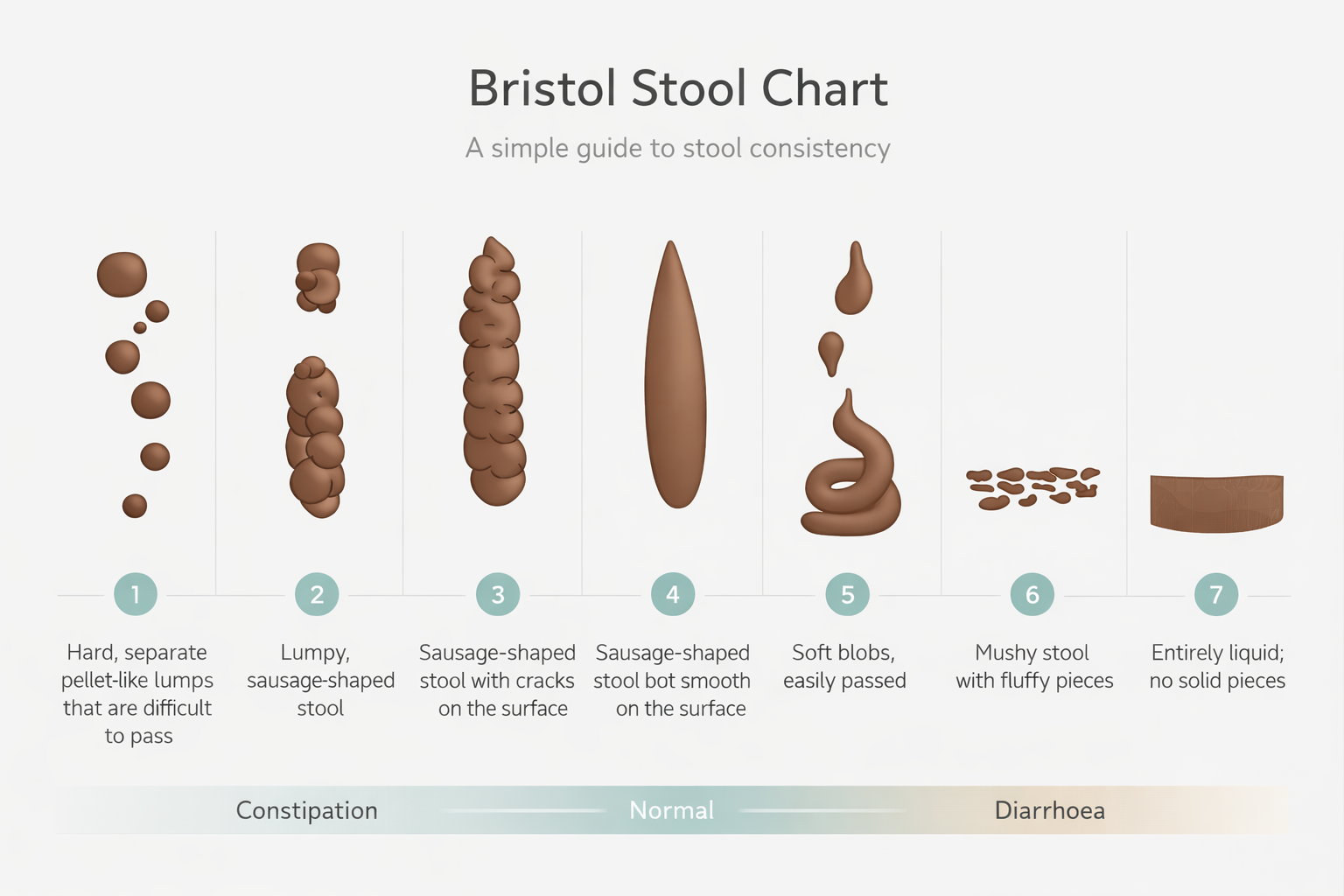
Bristol stool chart
Use the Bristol stool chart on the page and on the printable diary
This is one of the easiest ways to record stool consistency clearly. It is more useful than trying to write a long description every time.
Reference chart
If you are unsure which type fits best, choose the closest match rather than overthinking it.
The chart below is the same visual guide included in the PDF, so the page and printable diary stay aligned.
What it helps decide
Why clinicians keep asking for a bowel diary
The diary is not only about counting bowel actions. It often changes which branch of treatment actually makes sense.
It can show whether the main issue is hard stool or outlet dysfunction
A diary often helps separate a truly constipated hard-stool pattern from a blocked-emptying pattern where the stool reaches the rectum but the outlet still does not work smoothly.
It can uncover food, fluid, medicine, or IBS overlap
Sometimes the diary makes it obvious that the bowel is being shaped by trigger foods, caffeine, laxative timing, inconsistent stool form, or a wider IBS-type pattern rather than one simple diagnosis.
It can make urgency and leakage pathways much clearer
Leakage is easier to interpret once you can see whether the real story is loose stool, urge-led accidents, passive staining, wind loss, poor emptying, or a childbirth-related sphincter reserve problem.
It can show whether the next step is physio, bowel treatment, or more testing
A good diary often makes it easier to decide whether the next conversation belongs with stool optimisation, pelvic floor physiotherapy, posterior-compartment assessment, or a broader colorectal route.
The diary never makes the decision on its own, but it often turns an unclear bowel story into a much more focused treatment conversation.
Before your visit
The easiest way to use the diary before an appointment
You can keep this simple. The main aim is just to make sure the diary gets to the consultation in a usable form.
Download the 7-day printable version
The PDF gives you a full-week starting point, an example line, and the Bristol chart. If you need more space, you can print the log pages again.
Download 7-day diaryEmail it in if that is easier
If you prefer, you can send it ahead of the visit so the bowel pattern is already available when the consultation starts.
Email the diaryBring it with any bowel treatment history
It helps to bring or send the diary with any relevant laxative list, pelvic floor treatment details, scan results, or previous colorectal investigations if you have them.
Book an appointmentFrequently asked questions
Common questions about the bowel diary
What is a bowel diary?
A bowel diary is a practical record of when you opened your bowels, what the stool was like, how urgent it felt, whether there was seepage or leakage, what medicines or triggers were involved, and what was happening at the time. It helps turn a vague bowel story into something much easier to assess properly.
How many days should I fill it in for?
Usually somewhere between 3 and 14 days is reasonable. A full week is often a very good practical starting point because it captures both weekday and weekend patterns, but a shorter or longer diary can be used when that fits the clinical question better.
Do the days have to be consecutive?
Not necessarily. Typical days matter more than perfect consecutive days. If a day is completely unusual because of illness, travel, bowel prep, or a special event, it may be better to choose another day that reflects your usual bowel pattern more honestly.
Do I need to use the Bristol stool chart?
Yes, if possible. The Bristol stool chart is one of the easiest ways to describe stool consistency clearly rather than writing a long explanation, and it helps the diary line up properly with the assessment.
What should I record in the diary?
The useful details are the day and time, Bristol stool type, urgency, whether there was leakage or soiling, how much leaked, whether you changed a pad or clothing, any bowel medicines or triggers, and what was happening when the symptoms occurred.
Should I include food, drinks, laxatives, or other bowel medicines?
Yes. That often makes the pattern much easier to interpret, especially if loose stool, fibre supplements, laxatives, or meal-related triggers are part of the story.
Can a bowel diary help if I mainly feel blocked rather than leak?
Yes. It can still help show whether the pattern fits hard stool, repeated attempts, straining, splinting, poor emptying, or a wider outlet dysfunction story rather than a simple slow-bowel pattern.
When should I bring or send the diary?
It is most useful before or at the first bowel consultation, and also before pelvic floor physiotherapy, perineal ultrasound, or other testing if the symptom pattern is still not clear enough. Bringing it printed or emailing it ahead can both be useful.